The Brandenburg Gate is one of the main symbols of Berlin, Germany. Just north of it is the Reichstag. During the Cold War, the Reichstag was located in West Berlin, while the Brandenburger Gate was located in East Berlin. The gate was built between 1788-1791.

Brandenburg Gate
Berlin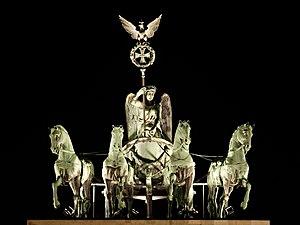
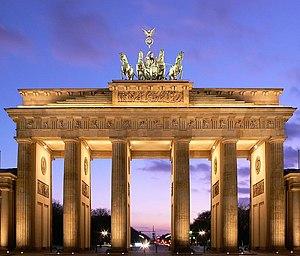
The Brandenburg Gate has twelve columns, six entrances and six exits. The pillars form a total of five roads, citizens only had the right to use the two outer gates. The middle road was reserved for royalty and important traffic crossings. At the top of the gate is the Quadriga.
After 1806, when Napoleon defeated Prussia at the Battle of Jena-Auerstedt, he dismantled the Quadriga and took it to Paris. In 1814, when Prussian General Ernst von Pfuel defeated Napoleon and captured Paris, he recaptured the Quadriga and brought it back to Berlin; The olive branch in Quadriga has been replaced with the Iron Cross.
When the Nazis came to power, they began to use the door as a symbol. II. The gate was destroyed during World War II, but not completely destroyed. The East and West Berlin governments restored the gate, but the gate was not opened until 1961, when the Berlin Wall was built.
In 1963, US President John F. Kennedy visited the Brandenburg Gate. In 1980, the mayor of West Berlin, Richard von Weizsäcker, said:
« As long as the Brandenburg Gate remains closed, the Germans will have a problem. »
Richard von Weizsäcker later became president of Germany at the time of reunification.
The gate later became a symbol of a united free Berlin and was reopened on 22 December 1989 when Helmut Kohl was Chancellor of West Germany.
Address
Pariser Platz, 10117 Berlin, Germany
